
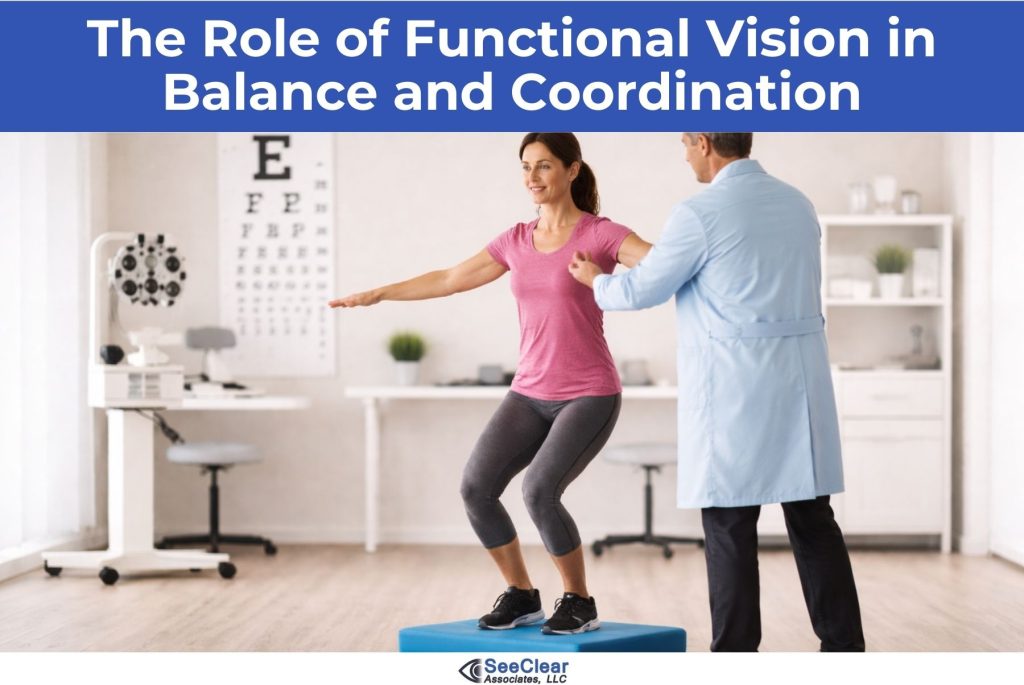
Balance and coordination are essential to nearly every movement we make—from walking across a room to driving, exercising, or simply standing upright. While many people associate balance primarily with the inner ear or muscles, vision plays a critical and often underestimated role in maintaining stability and coordinated movement.
At See Clear Associates, LLC, we specialize in evaluating how functional vision impacts posture, movement, and everyday stability. Understanding this connection can help patients of all ages improve safety, performance, and overall quality of life.
Understanding Functional Vision
Functional vision goes beyond how clearly you see letters on an eye chart. It refers to how effectively your eyes and brain work together to process visual information in real-world situations. This includes:
- Eye teaming (how well the eyes work together)
- Eye tracking and focusing
- Depth perception
- Peripheral awareness
- Visual processing speed
When functional vision is compromised, the brain receives inaccurate or delayed visual input—directly affecting balance and coordination.
How Vision Influences Balance and Posture
Your body relies on three major systems to maintain balance:
- Visual System – provides information about your environment and orientation
- Vestibular System – located in the inner ear, detects head movement and gravity
- Proprioceptive System – senses body position through muscles and joints
Vision acts as the primary guide, helping the brain interpret spatial relationships and anticipate movement. When visual input is unclear or inconsistent, the body compensates—often leading to poor posture, unsteady movement, or fatigue.
Visual Contributions to Stability Include:
- Maintaining upright posture
- Judging distances and steps
- Coordinating head, eye, and body movement
- Navigating uneven surfaces safely
Vision Problems That Can Affect Balance and Coordination
Functional vision issues may exist even when standard vision tests appear normal. Common vision-related contributors to balance challenges include:
- Binocular vision dysfunction (eyes not working well together)
- Poor depth perception
- Visual vertigo or motion sensitivity
- Eye tracking difficulties
- Uncorrected refractive errors
- Visual processing delays
These issues can cause symptoms such as dizziness, clumsiness, frequent falls, headaches, or difficulty with movement-based activities.
Everyday Activities Impacted by Vision-Related Balance Issues
When functional vision is compromised, daily tasks may become more difficult or unsafe, including:
- Walking up or down stairs
- Driving or parking
- Playing sports or exercising
- Reading while moving
- Navigating crowded or visually complex environments
Children may appear uncoordinated or struggle in sports, while adults may experience increased fall risk or motion discomfort.
How Functional Vision Care Can Help
At See Clear Associates, LLC, we take a comprehensive approach to evaluating visual function. Through detailed assessments, we identify how vision contributes to balance and coordination challenges.
Based on findings, care may include:
- Specialized lens prescriptions
- Vision therapy programs
- Coordination between vision and vestibular systems
- Ongoing monitoring of functional improvements
Addressing vision-related balance issues can lead to improved confidence, safety, and performance in everyday life.
Frequently Asked Questions (Q&A)
Q: Can vision problems really cause balance issues?
Yes. Vision provides critical spatial information to the brain. When visual input is inaccurate, balance can be compromised—even if the inner ear is functioning normally.
Q: I have 20/20 vision. Could I still have functional vision problems?
Absolutely. 20/20 vision measures clarity, not how well your eyes work together or process movement and space.
Q: Who can benefit from a functional vision evaluation?
Children, adults, and seniors—especially those experiencing dizziness, coordination difficulties, frequent falls, or visual discomfort during movement.
Q: Can functional vision therapy improve balance?
In many cases, yes. Improving eye coordination, tracking, and visual processing can enhance overall stability and movement efficiency.
Q: Are balance-related vision problems common in older adults?
Yes. As vision changes with age, balance can be affected, increasing fall risk. Early evaluation can help maintain independence and safety.
Contact Information
See Clear Associates, LLC
1811 Springfield Ave #1
New Providence, NJ 07974
📞 Phone: (908) 277-3116
🌐 Website: seeclearassociates.com
- Request An Appointment:
https://seeclearassociates.com/appointments/ - Patient Portal:
https://www.crystalpm.com/PatientPortal.jsp?crystalpmid=2543