
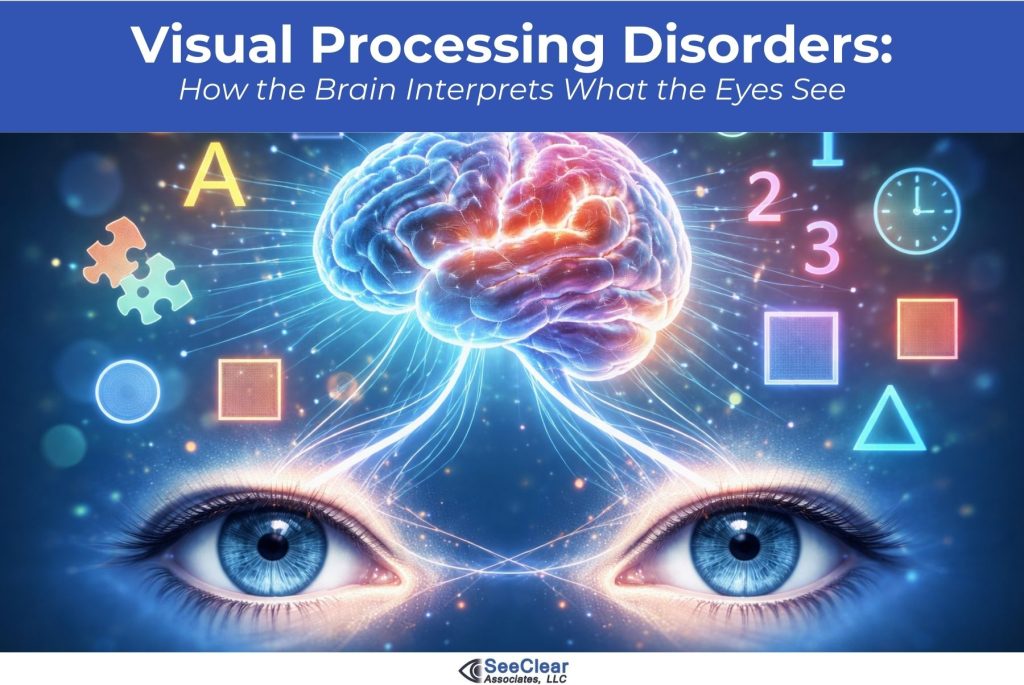
When people think about vision, they often assume it begins and ends with the eyes. But in reality, vision is a complex process that relies heavily on the brain. Even when the eyes are healthy and visual acuity is “20/20,” some individuals still struggle with reading, learning, coordination, or visual comfort. These challenges may be linked to Visual Processing Disorders (VPDs).
At See Clear Associates, LLC, we specialize in helping patients of all ages understand how their visual system works—and how targeted treatment can significantly improve daily life.
What Is Visual Processing?
Visual processing is the brain’s ability to interpret, organize, and respond to visual information received from the eyes. The eyes capture images, but it is the brain that gives those images meaning.
This process affects how we:
- Read and comprehend text
- Recognize shapes, letters, and faces
- Judge distance and depth
- Track moving objects
- Coordinate vision with movement
- Maintain visual attention and focus
When the brain has difficulty processing visual information efficiently, a Visual Processing Disorder may be present.
What Are Visual Processing Disorders?
Visual Processing Disorders occur when the brain struggles to make sense of what the eyes see. These difficulties are neurological, not related to intelligence, effort, or motivation. Many individuals with VPDs have normal eye health and may pass standard vision screenings, which is why these conditions are often overlooked.
VPDs are especially common in:
- Children with reading or learning difficulties
- Individuals with ADHD or dyslexia
- Adults with unresolved visual discomfort or headaches
- Patients recovering from concussions or neurological injuries
Common Signs and Symptoms of Visual Processing Disorders
Symptoms can vary widely and may show up at school, work, or home. Common signs include:
In Children
- Difficulty learning to read or slow reading progress
- Skipping lines or losing place when reading
- Letter or word reversals beyond expected age
- Poor reading comprehension
- Avoidance of near work (homework, books)
- Short attention span during visual tasks
- Poor handwriting or spacing issues
- Difficulty copying from the board
In Teens and Adults
- Eye strain, headaches, or fatigue with visual tasks
- Blurred or double vision when reading
- Trouble with visual memory
- Difficulty judging depth or distance
- Poor coordination or clumsiness
- Slow reading speed
- Difficulty with driving or sports
Types of Visual Processing Difficulties
Visual processing disorders can affect one or more specific skills, including:
- Visual Discrimination – Trouble noticing differences between letters, shapes, or symbols
- Visual Memory – Difficulty remembering what was seen
- Visual Sequencing – Trouble understanding the order of letters or numbers
- Visual Figure-Ground – Difficulty finding information in busy environments
- Visual-Spatial Skills – Challenges with direction, depth perception, or organization
- Visual-Motor Integration – Difficulty coordinating vision with movement (hand-eye coordination)
How Are Visual Processing Disorders Diagnosed?
A standard eye exam alone does not detect visual processing disorders. At See Clear Associates, LLC, we perform comprehensive functional vision evaluations that assess how the eyes and brain work together.
These evaluations may include testing for:
- Eye teaming and focusing
- Eye movement control
- Visual perception skills
- Visual-motor integration
- Depth perception and spatial awareness
The results help determine whether visual processing challenges are contributing to a patient’s symptoms.
Treatment Options for Visual Processing Disorders
The good news is that visual processing disorders are highly treatable.
Vision Therapy
Vision therapy is a customized, non-invasive treatment program designed to improve how the brain processes visual information. Therapy may include:
- Eye movement and tracking exercises
- Visual memory and perception activities
- Balance and coordination tasks
- Computer-based and hands-on exercises
Vision therapy trains the brain to work more efficiently with the eyes, leading to lasting improvements.
Specialized Lenses
In some cases, therapeutic lenses or prisms may be prescribed to reduce visual stress and support processing.
Integrated Care
Visual processing treatment often complements:
- Educational interventions
- Occupational therapy
- Speech-language therapy
- Neurodevelopmental support
Comprehensive Q&A: Visual Processing Disorders
Q: Can someone have perfect eyesight and still have a visual processing disorder?
A: Yes. Many individuals with VPDs have 20/20 vision but struggle with how their brain interprets visual information.
Q: Are visual processing disorders the same as learning disabilities?
A: No, but they can contribute to learning difficulties. VPDs affect visual efficiency, which can impact reading, writing, and attention.
Q: At what age can visual processing disorders be diagnosed?
A: Visual processing challenges can be identified in young children, school-age students, teens, and adults.
Q: Will my child outgrow a visual processing disorder?
A: Visual processing disorders do not typically resolve on their own, but targeted treatment such as vision therapy can lead to significant improvement.
Q: How long does vision therapy take?
A: Treatment duration varies based on the individual’s needs, but many programs last several months with measurable progress along the way.
Q: Does insurance cover vision therapy?
A: Coverage varies by plan. Our team can help guide you through insurance questions and available options.
Q: Can adults benefit from vision therapy?
A: Absolutely. The brain remains adaptable throughout life, and adults often experience reduced eye strain, improved reading comfort, and better visual efficiency.
Why Choose See Clear Associates, LLC?
At See Clear Associates, LLC, we take a whole-vision approach, looking beyond basic eyesight to understand how vision impacts learning, work, and quality of life. Our experienced team is dedicated to personalized care, patient education, and long-term results.
Contact Information
See Clear Associates, LLC
1811 Springfield Ave # 1
New Providence, NJ 07974
Phone: (908) 277-3116
Website: https://seeclearassociates.com
Request an Appointment: https://seeclearassociates.com/appointments/
Patient Portal: https://www.crystalpm.com/PatientPortal.jsp?crystalpmid=2543